Amboseli Safari: A Guide to Kenya's Elephant Kingdom
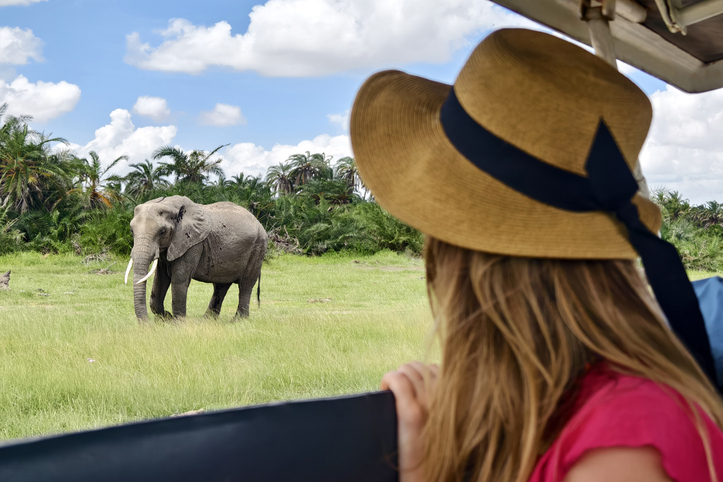
Planning an Amboseli safari? Our guide covers what to expect from Kenya's elephant kingdom, the best time to visit, and how to choose the right safari lodge for your trip.
Quick facts
- Size: 392 km² (151 sq mi)
- Altitude: 1,100 - 1,200 m
- Established: 1974 (as a National Park)
- Mammal Species: Approx. 80
- Bird Species: Over 420 recorded
- Best Time: Jun–Oct, Jan–Feb
- Nearest Airport: Amboseli Airstrip (ASV)
- Climate: Hot and dry
- Languages: English, Swahili
Amboseli Safari: What to Expect from One of Africa’s Most Iconic Landscapes
Amboseli National Park lies along the southern border of Kenya, directly facing Tanzania, with Mount Kilimanjaro rising beyond the horizon. It is one of the most recognisable safari destinations in Africa, yet its appeal is not built on complexity or variety in the traditional sense. Instead, it comes from a rare kind of clarity.
The landscape is open, often dry, and visually uncomplicated. Wide plains stretch across the park with very little obstruction, broken only by scattered acacia trees and pockets of wetland that draw life into otherwise quiet spaces. This openness changes the entire safari experience. You are not searching through thick vegetation or relying on chance encounters. You are watching wildlife move through a landscape that reveals rather than hides.
The name Amboseli comes from a Maasai word meaning “salty dust place,” which reflects the dominant character of the terrain. At the same time, underground streams flowing from Kilimanjaro feed permanent swamps across the park. This creates a steady water supply that supports wildlife throughout the year, even when everything around it appears dry. That contrast between dust and water defines Amboseli more than anything else.
The Elephants of Amboseli National Park
Amboseli has earned its reputation largely because of its elephants, but it is important to understand why they stand out here compared to other destinations. It is not simply about numbers, but about visibility, consistency and behaviour.
The park is home to large, well documented herds that move through the same areas with a natural rhythm. Because the terrain is so open, you are able to observe these movements clearly, often for extended periods of time. You are not just seeing elephants, you are watching how they interact, how they feed, how they respond to each other and to their environment.
Some of the bulls in Amboseli are among the most recognisable in Africa, known for their size and long, heavy tusks. These individuals have contributed to the park’s global reputation, particularly in photography and conservation circles. But beyond the iconic images, what stays with most visitors is the consistency of the experience. Encounters here tend to feel natural and unforced.
While elephants dominate the narrative, Amboseli supports a full ecosystem that includes predators such as lion and cheetah, as well as a wide range of plains game and birdlife. What makes all of this more accessible is the same factor that defines the park overall. You can see what is happening, and that changes how you experience it.
Fact Category | Detail |
|---|---|
Size and Weight | Largest land mammal. |
Trunk Versatility | A muscular, boneless 'nose' with over 40,000 muscles. |
Social Structure | Live in matriarchal herds led by the oldest female (matriarch). |
Intelligence and Memory | Highly intelligent with complex social behaviors. |
Lifespan | Can live for 60-70 years in the wild, |
Communication | Communicate through a variety of sounds |
Tusks | Tusks are elongated incisor teeth, growing continuously. |
What the Landscape Feels Like
Amboseli is built on contrast, and that contrast becomes more apparent the longer you spend there. At first, the dry plains can feel almost empty, with dust rising from the ground and very little movement across the horizon. But as you move through the park, the presence of water begins to reveal itself.
The wetlands are the heart of the ecosystem. Fed by underground streams from Kilimanjaro, they remain green even during the driest periods. These areas attract wildlife from across the park, creating pockets of activity that stand in stark contrast to the surrounding landscape. Elephants gather here to feed, birds concentrate in large numbers, and predators often position themselves nearby.
The rest of the park is made up of open plains, dry lake beds and scattered woodland. This simplicity is not a limitation. It is what gives Amboseli its distinctive character. There is very little visual noise, which allows both wildlife and landscape to stand out more clearly.
Kilimanjaro itself is not always visible, as it is often hidden behind cloud cover. But when it appears, it transforms the entire scene. What was already a strong visual setting suddenly becomes something far more powerful and memorable.
What You Can Expect on Safari
A safari in Amboseli tends to feel more grounded and less rushed than in many other destinations. Because wildlife is easier to locate and observe, there is less pressure to move constantly in search of sightings. Instead, you have the opportunity to spend time with what is already in front of you.
Elephant encounters are a central part of the experience. Herds move through the landscape in a steady and predictable way, often passing close to vehicles without changing their behaviour. This creates a sense of calm that is not always present in busier parks.
The open terrain also makes it easier to follow interactions between animals. Whether it is a group of elephants crossing a plain or a predator moving through the distance, you are able to see the full context of what is happening. This adds depth to the experience, turning simple sightings into something more meaningful.
There is also a strong sense of space in Amboseli. Even when there are other vehicles in the area, the landscape tends to absorb them. The park rarely feels crowded, and there is a quietness to the environment that allows you to focus on the details.
Best time to Visit Amboseli
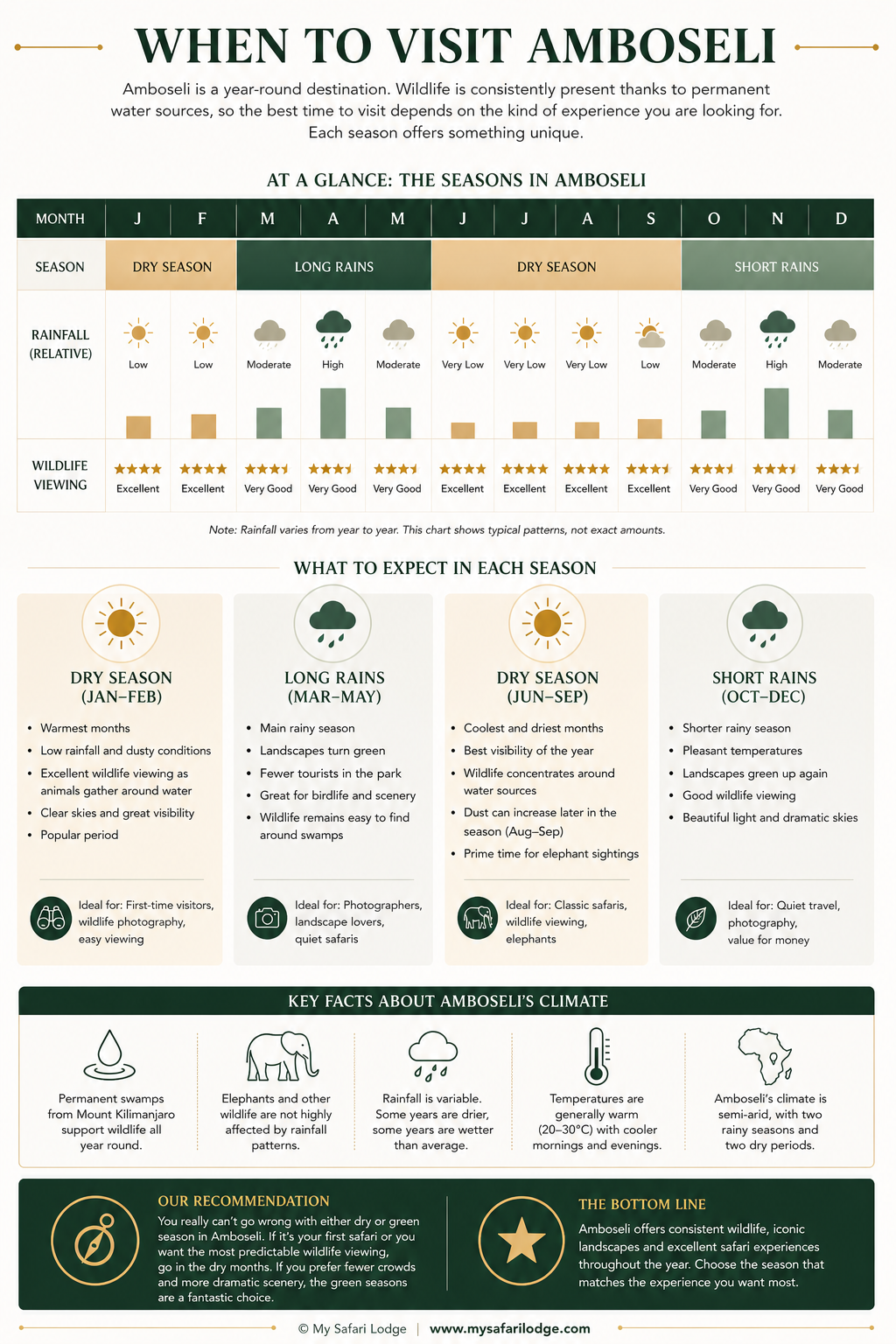
Amboseli is one of the few safari destinations where timing is less about access to wildlife and more about how you want to experience the landscape. Wildlife is present throughout the year, largely because of the permanent swamps that draw animals in regardless of rainfall. In practical terms, this means you are not planning your trip around whether animals will be there, but around the conditions in which you will see them.
From my experience in Amboseli, the dry periods tend to offer the most straightforward and consistent viewing. Vegetation is low, the air is clearer in the mornings, and animals move in predictable patterns between feeding areas and water. Elephants in particular become easier to follow across the open plains, and you often find yourself watching entire herds move through the landscape without obstruction. There is a certain simplicity to these months that works very well, especially if you value clarity over variation.
That said, the dry season is not always as clean as it sounds on paper. Later in the season, especially towards September and October, dust can build up significantly. This can add atmosphere, particularly at sunrise and sunset, but it also changes the feel of the park. Light becomes harsher during the day, and the landscape leans more towards that classic “Amboseli dust” look that some people love and others find repetitive over time.
The wetter periods bring a different balance. I have found that even a relatively light rain can change the mood of the park quite quickly. The plains take on more colour, the wetlands feel more active, and the light becomes softer and more varied. Skies tend to be more interesting, especially in the build-up to storms, which can add a lot to the overall experience even if wildlife visibility is slightly reduced in certain areas.
One thing that is often misunderstood is the impact of rain on wildlife in Amboseli. Unlike other destinations, where heavy rain can disperse animals over large areas, Amboseli remains relatively stable. The swamps continue to anchor activity, so even in wetter conditions, you are not losing access to wildlife in the same way you might elsewhere. The difference is more about atmosphere and movement than presence.
If I had to simplify it, the dry months suit those who want clarity, consistency and ease of viewing. The wetter months suit those who are willing to trade a small amount of predictability for a more varied and, at times, more visually interesting experience.
Amboseli does not have a narrow “best time” window. It is a destination that works across seasons, with each period offering a slightly different interpretation of the same landscape.
Is Amboseli Right for You?
Amboseli is not designed for everyone, and that is part of what makes it so effective for the right type of traveller. It offers a very specific kind of safari experience, one that prioritises observation over intensity.
If you are drawn to elephants and want to see them in a setting where their behaviour can be understood, Amboseli is one of the strongest choices available. It also suits those who appreciate open landscapes and a slower pace, where the experience builds over time rather than relying on constant action.
For photographers, the park offers a unique advantage. The clean backgrounds and wide views make it possible to create compositions that are difficult to achieve in more cluttered environments. Light, space and positioning become more important than simply being in the right place at the right time.
On the other hand, if your main focus is on high density predator activity or dramatic, fast moving scenes, there are other destinations that may deliver more consistently in that regard. Amboseli is quieter in its impact, but that quietness is exactly what many people are looking for.
The Wildlife Experience
Although elephants are the defining feature of Amboseli, the broader wildlife experience is well balanced and rewarding. Lions are present throughout the park, often resting during the heat of the day in the shade of acacia trees. Cheetahs take advantage of the open terrain, using visibility to hunt and move efficiently across the plains.
Giraffes, zebras and other herbivores are consistently present, forming the foundation of the ecosystem. Around the wetlands, birdlife becomes particularly active, with a wide variety of species gathering in areas where water is available.
What makes the wildlife experience here different is not just the range of species, but the way they are encountered. The openness of the landscape allows you to see how animals move through their environment, rather than encountering them in isolation. This creates a stronger sense of connection between species, landscape and behaviour.
A Brief Note on Lodges
Amboseli offers a range of safari lodges and camps, both within the park and in the surrounding areas. While accommodation is an important part of the overall experience, it should not define your understanding of the destination itself.
What matters at this stage is simply recognising that location plays a role. Being close to key access points can influence how much time you spend in the field, and different areas offer slightly different perspectives of the park.
Choosing the right lodge in Amboseli is a separate decision, and one that is best approached with a dedicated comparison once you understand what Amboseli itself has to offer.
What Amboseli Really Offers
Amboseli stands out because it removes distraction. It presents wildlife in a way that feels direct and unfiltered, allowing you to focus on what is actually happening rather than searching for it.
There is a clarity to the experience that is difficult to replicate. You see animals move through space, you understand their behaviour more easily, and you begin to notice details that might otherwise be missed.
It is not the most dramatic destination in Africa, and it does not try to be. What it offers instead is something more grounded and, in many ways, more lasting. If you are looking for a safari that prioritises observation, space and authenticity, Amboseli delivers that with consistency.